

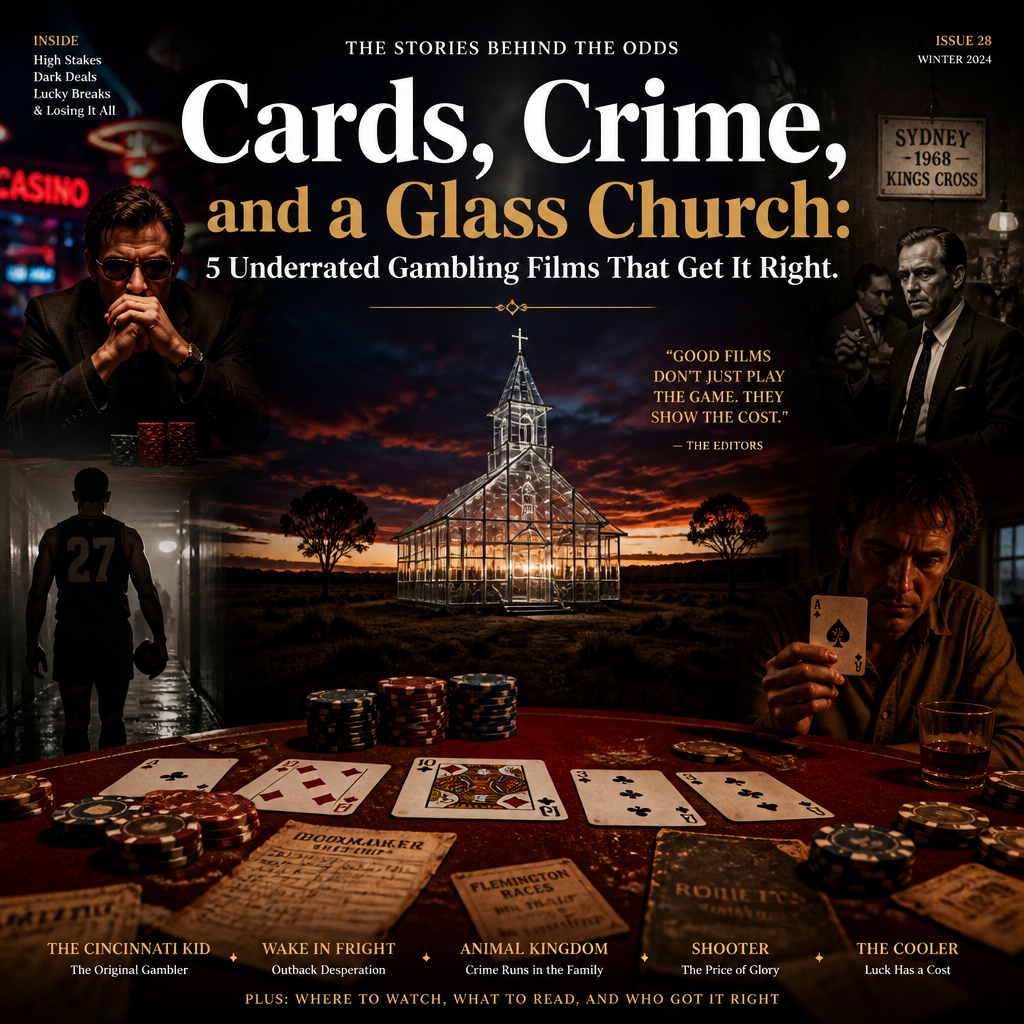

There’s a particular kind of tension that card games create on screen that poker chips and roulette wheels never quite manage. Cards require memory, deception, and the specific cruelty of watching someone else draw better than you. They’re intimate in a way casino floors aren’t. Two people across a felt table, each reading the other’s face for cracks.
Cinema hasn’t always known what to do with this. Half the time gambling in film is just shorthand for “this person has a problem,” or worse, a costume, a way to make a character look dangerous without actually writing them as dangerous. If you want to understand what card games feel like from the inside, you’re better off finding a real deck and a real opponent. Something like 500 card game, an Australian classic that rewards genuine attention and punishes the cocky, will teach you more about reading a hand than most films manage in two hours. That said, some films do get it right. And a handful of Australian ones, in particular, get it in ways that surprise you.

The Priest Who Couldn’t Fold [1997]
Oscar and Lucinda (1997) is probably the most beautiful film about compulsive gambling ever made, and also about two people who absolutely should not be around each other. It’s an adaptation of Peter Carey’s novel, directed by Gillian Armstrong, and Ralph Fiennes and Cate Blanchett are both doing the best work of their respective early careers, which is a strange sentence to type given what came after.
Oscar is a clergyman. Lucinda is a glass factory heiress. They meet on a ship and bond over cards, not because cards are glamorous here, but because for both of them, gambling is the only honest language they speak. The film understands something that gets lost in flashier casino dramas: that for certain people, a bet isn’t a thrill. It’s a theological position. Oscar gambles because he genuinely believes God is guiding his luck, which is either madness or faith depending on how the evening goes. Lucinda gambles because it’s the one space where the social constraints strangling a nineteenth-century woman briefly fall away.
The famous bet at the heart of the film, a glass church transported through the Australian wilderness, is so magnificently absurd that it works precisely because neither character treats it as absurd. It is, for them, entirely serious. The film earns its melancholy.
Poker Face, Empty House [2007]
Lucky You (2007) is a much less elegant film and it knows it, which is almost endearing. Drew Barrymore is in it as a love interest who contributes very little to the story and seems to know it. The poker scenes at the World Series in Las Vegas are genuinely good, though. The film was shot partly during the actual 2003 WSOP, which gives it a texture that studio backlot productions can’t fake.
Eric Bana plays Huck, a professional poker player trying to make the final table while working out his complicated feelings about his father, played by Robert Duvall, who is also trying to make the final table. The dramatic architecture is not subtle. Where Lucky You works is in its treatment of poker as a way of avoiding intimacy rather than seeking it, the opposite of what’s happening in Oscar and Lucinda, where cards bring two people dangerously close. Huck plays better when he’s alone and loses when he lets anyone in. The film can’t quite commit to that being a tragedy, which is where it loses its nerve, but as a document of competitive poker culture it’s more honest than most.
Not Your Casino, Mate [2002]
Dirty Deeds (2002) is operating in an entirely different register. It’s a crime comedy set in 1969 Sydney, and it is extremely Australian in the way that means chaotic, slightly shambolic, and funnier than it has any right to be. Bryan Brown plays Barry Ryan, a local crime boss running illegal gambling dens, and the plot kicks off when Chicago mob representatives arrive uninvited to muscle in on his territory.
The interesting thing about the film is what it says about Australian gambling culture specifically. The sense that gambling here has always been semi-communal, embedded in pubs and backrooms and local power structures rather than the corporate anonymity of Las Vegas. Barry isn’t running his operation out of ego. It’s his neighbourhood. The Americans don’t understand this, and that incomprehension is where most of the comedy and most of the violence comes from. It’s not a great film. The tonal shifts are occasionally jarring. But it captures something real about how gambling functions in Australian life as infrastructure rather than vice.
The Punt That Costs Everything [2016]
Broke (2016) is the one on this list that will genuinely make you uncomfortable if you follow the NRL. It’s a documentary, based on testimonies from former players, about gambling addiction and match-fixing in Australian rules football, and it earns its discomfort by refusing to be sensationalist about any of it.
Where Dirty Deeds treats gambling as a cultural institution with its own logic and hierarchy, Broke shows what happens to working-class men who grow up in that same culture and then find themselves with sudden money, sudden status, and absolutely no framework for managing either. The match-fixing element is harrowing not because it’s dramatic but because it sounds so mundane when the players describe it. Nobody felt like a criminal. Everybody felt like they were solving a problem. That is the actual texture of addiction, and this film is one of the few Australian productions willing to sit in it without flinching.
He Only Wins on Sundays [1996]
I’m going to guess you haven’t seen Winner (1996), and I’m going to suggest you fix that. It’s a small American film about a man who only wins money on Sundays, never more than a thousand dollars, with mechanical certainty. A sex worker trying to clear a fifty-thousand-dollar debt attaches herself to him. That’s the plot.
The film is strange and melancholy and operates at a register somewhere between fable and realism. It handles gambling not as addiction or crime or competition but as a kind of inexplicable grace, something that arrives and departs on its own schedule with no regard for what you deserve. Vincent D’Onofrio plays the man with the Sunday luck and he barely speaks. The film barely explains itself. Watch it late at night when you’re in the mood for something that trusts you to sit with ambiguity and doesn’t feel the need to wrap everything neatly before the credits roll.
Five films, almost every emotional register gambling actually operates in. Obsession, community, addiction, something close to grace. None of them are perfect. Most of them are worth your time anyway.